
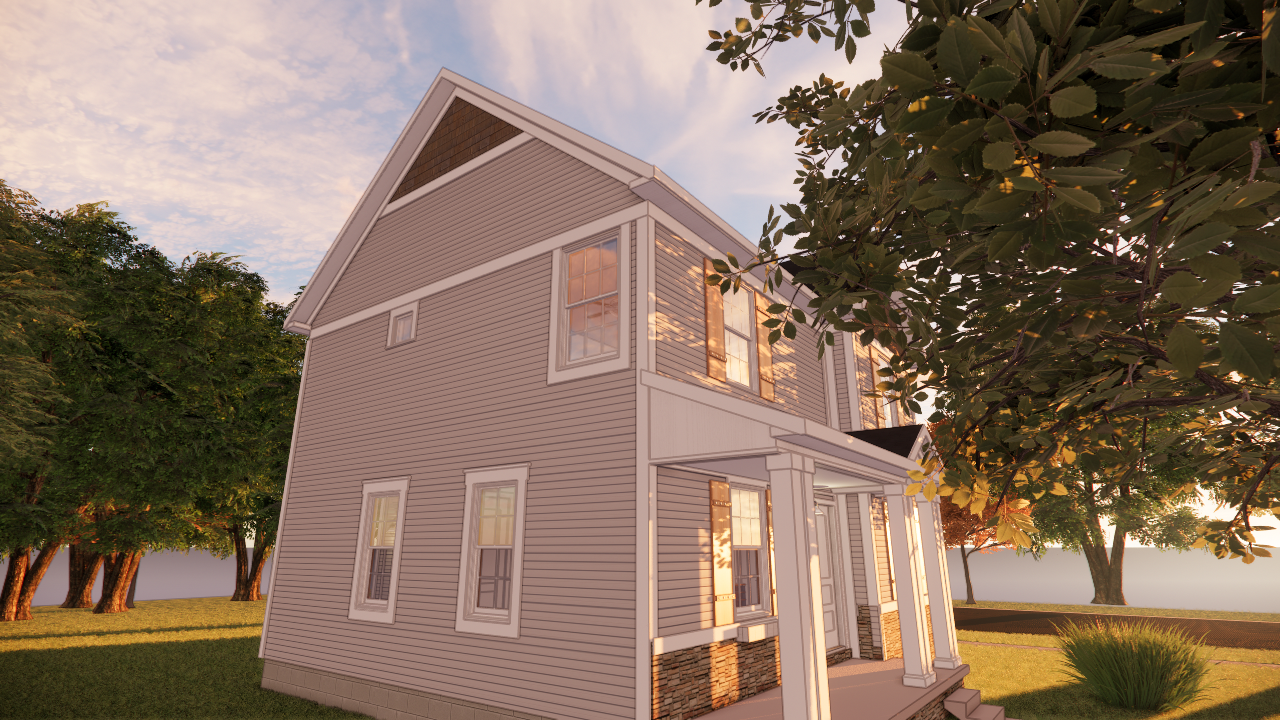
Why So Many Porch Additions Feel “Off”
A front porch should feel like it has always been there.
And yet, most porch additions look like an afterthought. The columns are too thick. The roof pitch is wrong. The proportions overpower the original entry. What was once a modest, dignified home suddenly feels bulky and confused.
The issue is rarely craftsmanship.
It is proportion.
Older homes from the 1940s–1970s were built with quiet discipline. When you add a porch without respecting that geometry, the entire façade shifts out of balance.
The goal is not to “add charm.”
The goal is to reveal the charm that already exists.
Start With the Roofline, Not the Columns
Most homeowners focus on column style first. That is backwards.
The roofline defines the porch’s relationship to the house. If the pitch is too steep, it competes with the main roof. If it is too shallow, it looks temporary.
On a 1950s Colonial:
Match the main roof pitch or use a subtle shed roof with disciplined trim.
Keep the porch width aligned with window rhythm.
On a Ranch:
Emphasize horizontality.
Extend the eave line rather than introducing vertical mass.
The porch roof should feel like a continuation, not a hat placed on top.
Column Scale Determines Everything
Columns must visually carry the weight above them.
Oversized fiberglass columns are one of the fastest ways to make a modest home feel inflated. Undersized metal posts make it feel temporary.
The correct column width is determined by:
Roof load
Span distance
Overall façade scale
Slim, well-proportioned square columns often feel more authentic on postwar homes than ornate round columns borrowed from other eras.
Restraint is your ally.
Align the Entry With Intention
A porch should strengthen the front door, not bury it.
Before building:
Confirm the door sits in visual center.
Adjust trim scale to support the new depth.
Maintain symmetry where the house already had it.
If your original façade was asymmetrical, the porch should follow that logic instead of forcing artificial balance.
The porch should clarify the entry sequence, not complicate it.
Respect Materials and Texture
Many porch additions fail because the materials don’t match the home’s era.
Brick foundation below? Continue that base through the porch piers.
Wood siding above? Maintain the same reveal and shadow line.
Avoid mixing stone veneer, vinyl shake, decorative brackets, and multiple trim profiles on one small façade.
Older homes thrive on simplicity.
One dominant material. One supporting detail. Clean transitions.
Size Is Not the Goal
A larger porch is not always a better porch.
Depth should allow functional seating, but not overwhelm the façade. Eight feet is often ideal for livability without distortion. Twelve feet on a small Cape can completely change its identity.
The porch must feel proportionate to the house, not proportionate to Pinterest.
Why Design Must Come Before Construction
Porches are deceptively complex. They affect:
Rooflines
Drainage
Structural loads
Window alignment
Entry hierarchy
Once built, they are expensive to correct.
That is why a scaled exterior study should always precede construction drawings. You need to see how the massing works in context before you commit.
In the Home Revival Blueprint, we model porch options against your existing façade so you can evaluate proportion before a single footing is poured.
Because when a porch is right, no one asks when it was added.
They assume it was always there.
Your Next Step
If you are considering a front porch addition, do not start with a contractor sketch.
Start with proportion.
👉 Book your Home Revival Blueprint Session and discover how to design a porch that strengthens your home’s character instead of overwhelming it.
